What Do Instructional Designers Actually Do All Day?
Jun 29, 2026
What Do Instructional Designers Actually Do All Day?
By Dr. Robin Sargent · Founder, IDOL Academy · Last updated: January 30, 2025 · 9 min read
Quick answer
What do instructional designers do? They analyze performance problems, design learning solutions, build digital courses and training materials, and measure whether those solutions actually work. The day-to-day is a mix of writing, building, collaborating with subject matter experts, and managing feedback from stakeholders.
In this article
- The core job: what instructional designers are actually hired to do
- A realistic look at an instructional designer's typical week
- The tools instructional designers use every day
- How instructional design differs from teaching
- Where instructional designers work and who employs them
- Frequently asked questions
Instructional designers build learning experiences that change behavior. On any given day, that means writing scripts, building courses in tools like Articulate Rise or Storyline, meeting with subject matter experts, and reviewing stakeholder feedback. If you are wondering what do instructional designers do and whether your background could translate, the short answer is: it is more systematic than creative, more collaborative than solo, and far more transferable from teaching or training than most job postings make it sound.
The core job: what instructional designers are actually hired to do
Strip away the jargon and the job is this: someone in the organization has a performance problem. Employees are not onboarding efficiently. Sales reps are not following the new process. Customer service agents are giving inconsistent answers. The instructional designer's job is to figure out whether training will solve that problem, and if so, build the training.
That process follows a framework most IDs know as ADDIE: Analyze, Design, Develop, Implement, Evaluate. Or a more iterative version called SAM (Successive Approximation Model). The specific model matters less than the underlying habit: you do not start building until you understand the problem.
Here is what the core responsibilities look like in practice:
- Needs analysis: Talking to managers, employees, and stakeholders to identify the actual gap between current and desired performance.
- Learning objective writing: Translating business needs into specific, measurable outcomes. "Learners will be able to..." is the sentence you write over and over.
- Storyboarding and scripting: Planning out the structure of a course or module before a single slide is built. This is where most of the real design thinking happens.
- Content development: Building the actual deliverable. Usually an e-learning module, a facilitator guide, a job aid, or a blended curriculum.
- SME collaboration: Working with subject matter experts to make sure your content is accurate, then translating their expertise into something learnable.
- Review and revision cycles: Receiving feedback from stakeholders, incorporating changes, and managing version control without losing your mind.
- Evaluation: Measuring whether the training actually moved the needle. This ranges from simple learner satisfaction surveys to more rigorous behavior-change assessments.
According to the U.S. Bureau of Labor Statistics, employment of instructional coordinators is projected to grow 2 percent through 2032, with a median annual wage of $74,620. The BLS category includes corporate IDs, and the actual salary range in private-sector L&D roles runs considerably higher once you factor in senior and specialist positions.
A realistic look at an instructional designer's typical week
No two weeks look identical, but here is a realistic snapshot of what an ID in a mid-size corporate L&D role might actually do across five days.
| Day | Primary activities | Deliverable or output |
|---|---|---|
| Monday | Kickoff call with stakeholders, needs analysis interviews | Project brief or scope document |
| Tuesday | SME interview, content research, learning objective drafting | Objectives list, content outline |
| Wednesday | Storyboard writing, slide scripting in Word or Google Docs | Draft storyboard for SME review |
| Thursday | Building in Articulate Rise or Storyline, adding interactions | Alpha version of the module |
| Friday | Reviewing feedback, revisions, status update to project manager | Revised module, updated project tracker |
What surprises most career changers is how much of the job is communication, not building. Writing a great storyboard is only useful if your stakeholders understand and approve it. Managing a review cycle without getting buried in conflicting feedback is a skill you develop on the job. So is knowing when to push back on a request that would make the training worse.
"The best instructional designers are not the ones who build the prettiest slides. They are the ones who ask the right questions before they build anything at all." — Dr. Robin Sargent
Want to see if instructional design is the right move for you?
IDOL Academy is a GNPEC-authorized 24-week program that combines 16 Credly-verified credentials, built-in AI training, and a real internship milestone, all at a price point below comparable bootcamps.
Try IDOL Academy FreeThe tools instructional designers use every day
The software stack varies by organization and role, but there is a core set of tools that shows up in the vast majority of ID job postings. Knowing these tools is not optional. It is table stakes.
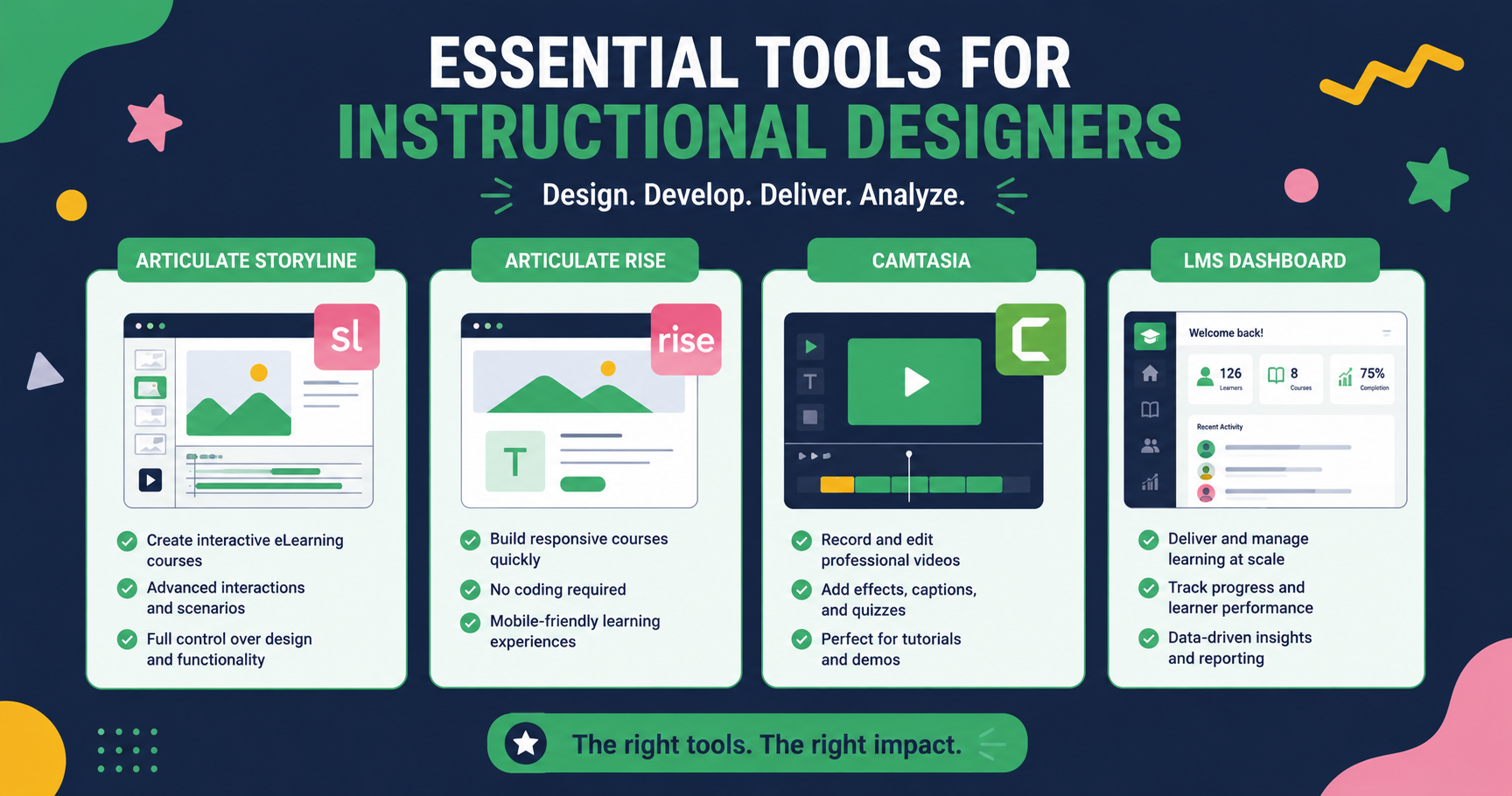 The core software stack most instructional designers encounter in corporate L&D roles.
Here is what you will encounter most often:
- Articulate Storyline 360: The industry-standard tool for interactive e-learning. If a job posting lists one authoring tool, it is almost always this one.
- Articulate Rise 360: A web-based, responsive course builder. Faster to build in than Storyline, with less interactivity. Both tools are part of the Articulate 360 subscription.
- Camtasia: Screen recording and video editing. Used for software simulations, tutorial videos, and screencasts.
- Learning Management Systems (LMS): The platform where courses live. Common corporate LMS platforms include Cornerstone OnDemand, Workday Learning, SAP SuccessFactors, and TalentLMS.
- Canva or Adobe Creative Suite: For visual design work, custom graphics, and branded templates.
- Vyond or Synthesia: For animated or AI-generated video content. AI video tools are increasingly common in modern ID workflows.
- Google Workspace or Microsoft 365: For storyboards, scripts, project tracking, and stakeholder communication. Most of your written work lives here before it goes into a development tool.
- AI writing and design tools: ChatGPT, Claude, and similar tools are now part of many IDs' daily workflow for drafting content, generating quiz questions, and accelerating storyboarding.
You do not need to master all of these before you apply for your first role. Most employers expect a learning curve on their specific stack. What they do not want to teach you is the design thinking that makes you effective in any tool. That is the part you need to bring with you.
IDOL Academy includes tool training across several of the most in-demand platforms. The software licenses themselves are the learner's responsibility, but the program teaches you how to use them in real project contexts, not just as isolated tutorials.
How instructional design differs from teaching
This is the question most teachers ask me, and it deserves a direct answer. Because the overlap is real, but so is the gap.
Teachers deliver instruction. Instructional designers design it. That sounds like a small distinction, but it changes almost everything about the work.
| Dimension | Teaching (K-12 or Higher Ed) | Instructional Design (Corporate L&D) |
|---|---|---|
| Primary output | Lesson plans, live instruction | E-learning modules, facilitator guides, job aids |
| Audience | Students in real time | Adult employees, often asynchronous |
| Success metric | Grades, test scores, engagement | Behavior change, performance improvement, business outcome |
| Collaboration | Primarily solo in the classroom | Cross-functional: SMEs, managers, HR, vendors |
| Revision cycles | Informal, year-over-year updates | Formal review and approval process with stakeholders |
| Schedule | Academic calendar, fixed schedule | Project-based deadlines, often remote and flexible |
The skills that transfer directly from teaching are real: breaking down complex information, writing clear learning objectives, understanding how people learn, managing a classroom full of competing needs. Those are genuine assets. What most teachers have to develop from scratch is project management, stakeholder communication, and the ability to design for someone else's delivery rather than your own.
If you want to go deeper on this transition, the guide to moving from teaching into instructional design covers the full career pivot step by step.
Where instructional designers work and who employs them
The short answer: everywhere. Any organization large enough to have a training function hires instructional designers.
In practice, you will find the most ID job postings in these sectors:
- Technology: Companies like Google, Amazon, Microsoft, and Salesforce run large internal L&D teams. Remote roles are common. Salaries in this sector run higher than the national average.
- Healthcare: Hospitals, health systems, and pharmaceutical companies need IDs for compliance training, clinical onboarding, and patient education programs.
- Financial services: Banks, insurance companies, and fintech firms use IDs for regulatory compliance, product training, and sales enablement.
- Consulting and L&D agencies: Boutique firms and larger consultancies hire IDs to build training for their clients. This path tends to offer more variety but less stability than in-house roles.
- Higher education: Universities and colleges hire IDs to support faculty in building online courses. Pay is often lower than corporate, but the benefits and mission can be compelling.
- Government and military: Federal agencies and branches of the military maintain significant L&D operations. These roles often require citizenship and offer strong job security.
- Freelance and contract: A growing number of IDs work independently, taking on project-based work from multiple clients. The freedom is real. So is the need to market yourself and manage your own pipeline.
IDOL Academy alumni have landed roles at organizations including Amazon, Apple, Nike, Uber, and Salesforce. They have also built successful freelance practices and joined boutique L&D consulting firms. The variety is one of the things that makes this field worth considering. You are not locked into one industry or one type of organization.
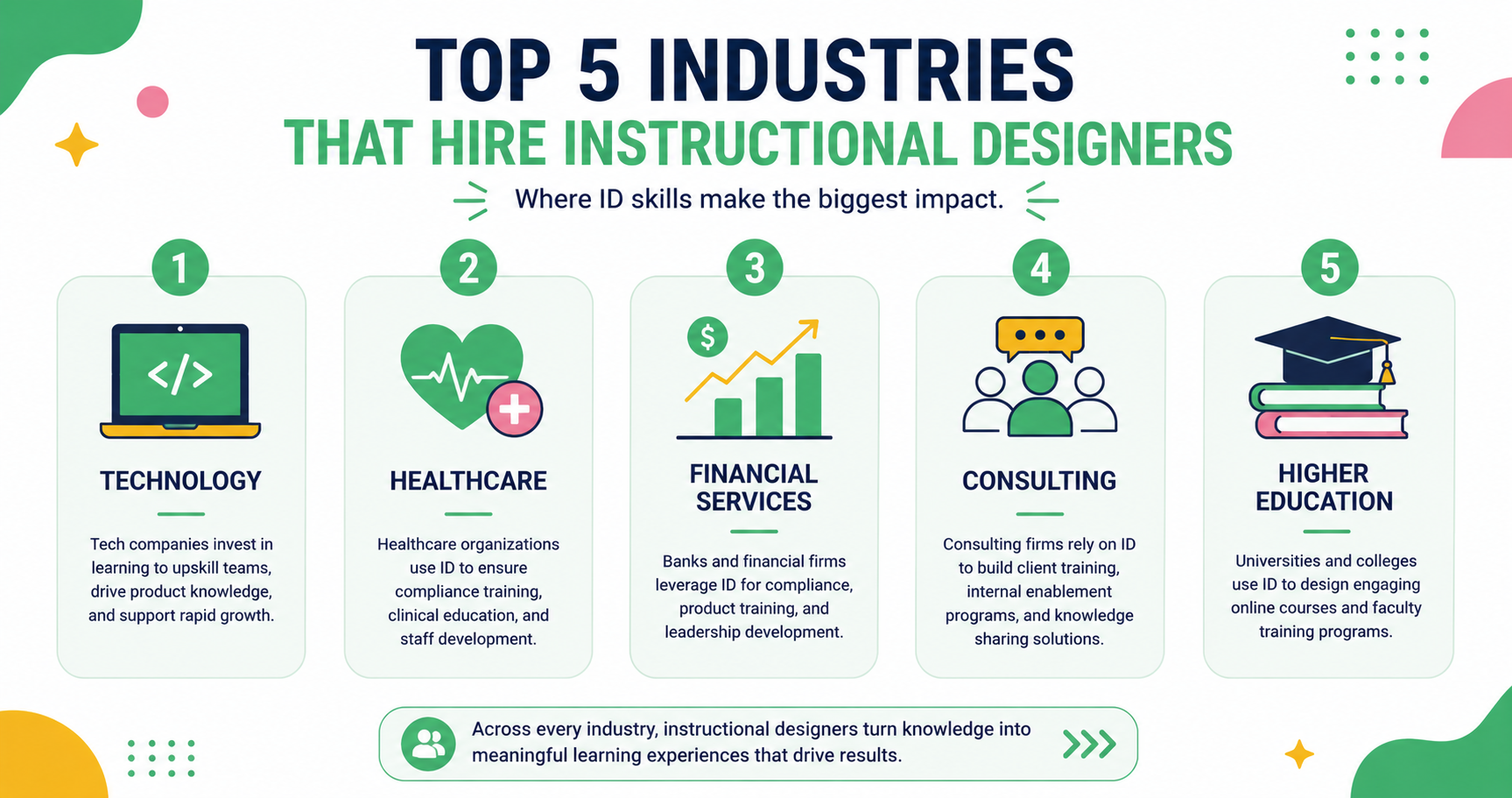 Instructional designers are employed across nearly every major industry sector.
Remote work is genuinely the norm in this field. Because the work is primarily digital and asynchronous, most ID roles can be performed from anywhere. That is not a pandemic-era anomaly. It is a structural feature of a job where your deliverable is a file, not a room you have to show up in. Browse the IDOL Academy Knowledge Base for more on navigating the ID job market, salary research, and portfolio building.
Frequently Asked Questions
What do instructional designers do every day?
Most instructional designers spend their days in a mix of needs analysis, content development, stakeholder meetings, and revisions. A typical week includes writing learning objectives, scripting e-learning modules, building content in tools like Articulate Storyline or Rise, and collaborating with subject matter experts to make sure the material is accurate and teachable.
Is instructional design a desk job?
Mostly, yes. Instructional design is primarily a computer-based role. You spend the majority of your time writing, building digital learning assets, and communicating with stakeholders over email, Slack, or video calls. Some roles involve occasional in-person facilitation or observation, but that is not the norm for most ID positions.
Do instructional designers work alone or on teams?
Both, depending on the organization. At large companies, instructional designers typically work within an L&D team alongside other IDs, project managers, and sometimes graphic designers or video producers. At smaller companies or as a freelancer, you may be the only ID, which means wearing more hats and managing the full project lifecycle yourself.
What software do instructional designers use?
The most common tools are Articulate Storyline and Articulate Rise for e-learning development, along with a learning management system like Cornerstone, Workday Learning, or TalentLMS for deployment. Many IDs also use Camtasia or Vyond for video, Canva or Adobe Creative Suite for visual design, and project management tools like Asana or Notion to keep projects on track.
How is instructional design different from teaching?
Teachers deliver instruction live, in real time, to a group of students. Instructional designers build the system behind the learning: the courses, the materials, the assessments, and the strategy. You are designing for someone else to experience, often asynchronously, rather than standing in front of a room. That shift from delivery to design is the core difference most teachers navigating this transition have to make.
Can instructional designers work remotely?
Yes. Instructional design is one of the most remote-friendly careers in the professional world. Because the work is primarily digital, most ID roles can be performed from anywhere with a reliable internet connection. Remote and hybrid ID positions are consistently listed by major employers including Amazon, Google, and Salesforce.
Now you know what instructional designers do, what their days actually look like, and where the field can take you. If this sounds like the kind of work you want to be doing, the best next step is to try it before you commit to a full program.
Want to see if instructional design is the right move for you?
IDOL Academy is a GNPEC-authorized 24-week program that combines 16 Credly-verified credentials, built-in AI training, and a real internship milestone, all at a price point below comparable bootcamps.
Try IDOL Academy Free```